
How to Reduce Fall Risk for Seniors with Dementia
Falls are one of the most common and serious concerns for families caring for a loved one with Alzheimer’s or dementia. Changes in memory, judgment, balance, and spatial awareness all increase the likelihood of a fall. This guide takes a closer look at what families and care teams can do to keep loved ones safer.
Why Dementia Increases Fall Risk
Dementia affects more than memory. As the condition progresses, a number of underlying factors can make fall risk higher. Understanding these underlying factors is the first step toward meaningful prevention:
- Impaired depth perception
- Slowed reaction time
- Trouble coordinating movement
- Gait changes (shuffling steps, reduced stride length difficulty navigating stairs or uneven surfaces)
- Certain medications used to manage dementia-related causes dizziness
A Home Environment That Supports Safety and Reduce Fall Risk
The physical environment plays a major role in fall prevention. Adjustments to a living space can make a measurable difference for someone navigating the world with cognitive impairment.
Here are a few ways to improve spaces for individuals with memory loss:
- Reduce clutter
- Clear pathways throughout common areas and bedrooms allow for easier, safer movement
- Remove loose rugs, electrical cords running across floors, and furniture positioned too close together
- Ensure bright lighting and add motion-activated nightlights in hallways, bedrooms, and bathrooms
- Ensure grab bars are installed in bathrooms near the toilet and inside the shower
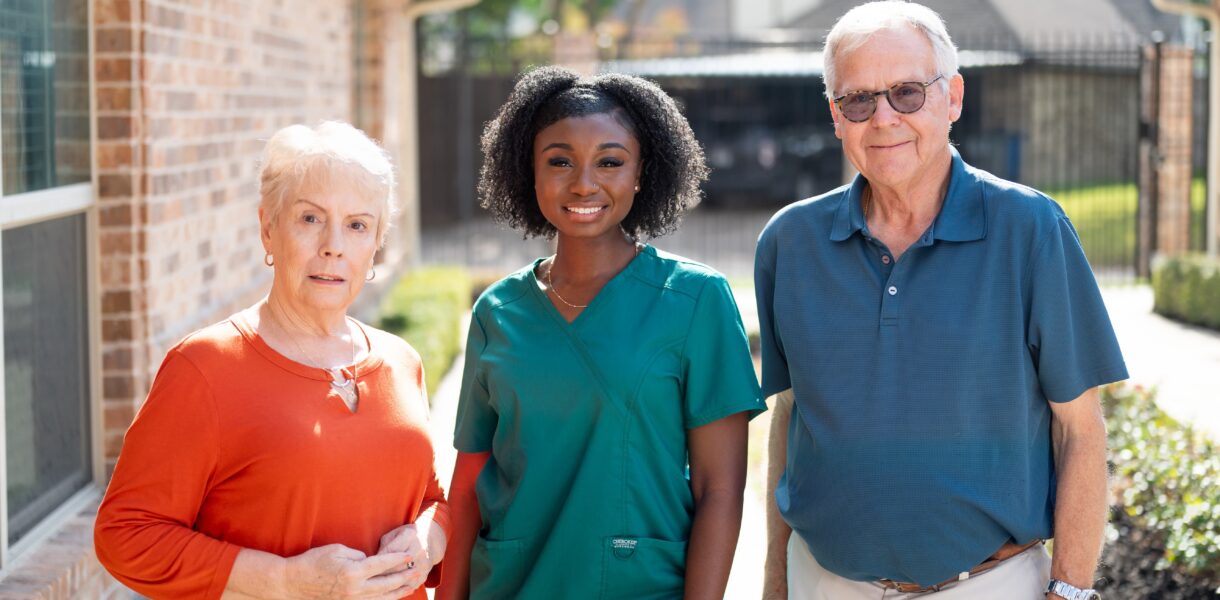
At Avalon Memory Care, all locations are designed with safety built into the architecture — single-story, ranch-style homes with secured outdoor spaces that allow residents to move freely without the hazards of stairs or unsupervised exits. That home-like structure eliminates many of the environmental risks families struggle to manage.
Routine and Care to Reduce Fall Risk for Seniors with Dementia
A consistent daily routine reduces the disorientation that often leads to unsafe movement. When a person with dementia knows what to expect throughout the day, they are less likely to wander unexpectedly or move quickly in moments of confusion.
Supervision during higher-risk activities like getting up from a seated position, transitioning between rooms, or using the bathroom is particularly valuable. Many falls happen during these brief moments of transition.
When to Reassess the Level of Care for Seniors with Memory Loss
Sometimes fall risk becomes a signal that the current care setting is no longer the safest option. When a loved one has experienced multiple falls, requires close supervision throughout the day and night, or lives with a caregiver who is stretched beyond capacity, it may be time to consider a dedicated memory care community.
Memory care communities staffed by trained professionals who understand dementia-related behaviors can provide the attentive, around-the-clock oversight that keeps residents safest. The environment, staffing ratios, and structured programming are all designed to meet the needs of individuals with memory loss.
Families who are weighing their options are welcome to connect with an Avalon team to learn more about what purposeful memory care looks like day to day.

See More Articles
- Visiting Your Aging Parent With Memory Loss at Avalon Memory Care

As a loving son or daughter, you naturally want the best of care for your senior parent. The compassionate assisted living caregivers at Avalon Memory Care want you to know that while your parent is living with us, he or she will receive nothing less than respectful, loving care within our comfortable, safe, and fully-staffed
- Celebrating New Year’s Day in Memory Care

Families often find that celebrations with their loved ones in memory care are easier when they embrace new traditions. For instance, it may not be practical to expect your loved one to stay up until midnight on New Year’s Eve. Instead, consider throwing a New Year’s Day celebration, complete with a countdown to the first
- Understanding Parkinson’s Disease and Dementia

Parkinson’s disease is an incurable neurological disorder, with progressively worsening complications. Perhaps the most well-known symptom of Parkinson’s is a hand tremor, but it can also cause speech changes, muscle rigidity, and impaired posture. Eventually, as the disease progresses, more than half of all individuals with Parkinson’s will require dementia care. This particular type of
Our team is committed to delivering personalized care for your loved one
Michelle Strong
All Star Hospice
Christian Care House Calls
Testimonials
Carol Rup
Jim Howard
Greg and Cindy Heitzman
Downloadable Resources
We Are Avalon
Discover the heart of our community; download ‘We Are Avalon’ to get to know our dedicated team and our commitment to providing a warm, family-like environment.
Transitional Care Guide
If you’re considering a transition, we’re here to help; download our Transitional Care Guide for compassionate guidance through each step of the process.
Schedule a Tour
Visit one of our 30+ campuses and experience our unique approach to memory care.